Occupational Therapy Community of Practice on Assistance Animals

Occupational Therapy Community of Practice on Assistance Animals

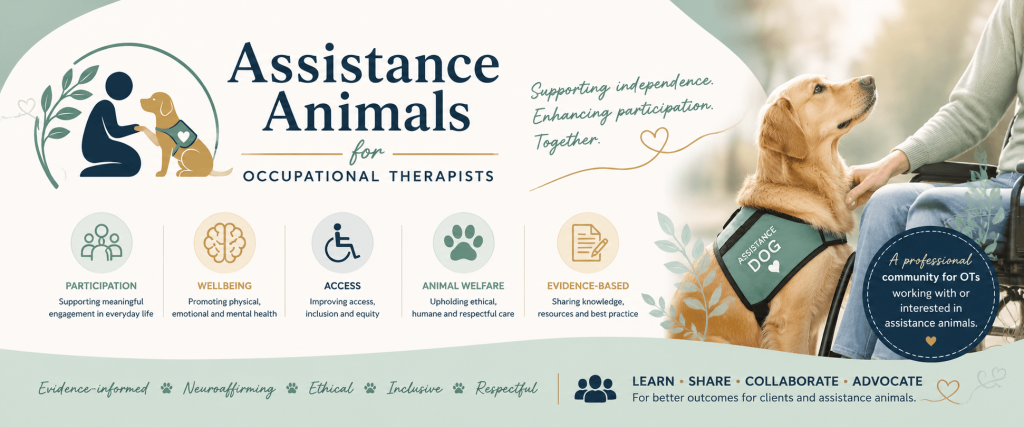
The Working Animals Federation of Australia (WAFA) announces the establishment of a dedicated Occupational Therapy (OT) Community of Practice focused on assistance animal-related practice, delivered through a professional Facebook-based platform.

The OT Assistance Animal Group has been developed as a structured peer learning network and professional knowledge exchange forum, intended to support occupational therapists, OT students, and invited allied health professionals engaged in, or developing competence in, assistance animal-related practice within disability, mental health, and community participation contexts.

The establishment of this Community of Practice reflects an emerging need for interdisciplinary alignment, particularly across occupational therapy, assistance animal training, disability support systems, and regulatory frameworks. As assistance animals become increasingly integrated within functional capacity building, participation-based intervention, and psychosocial support planning, there is a corresponding requirement for consistent, ethically grounded, and evidence-informed professional discourse.

This initiative is positioned within contemporary understandings of communities of practice theory, whereby situated professional learning occurs through sustained engagement, shared inquiry, and collective development of practice knowledge. The group is designed to facilitate peer-to-peer clinical reasoning, reflective dialogue, and the articulation of emerging best practice standards in a developing area of cross-sector practice.

Core areas of focus include, but are not limited to, the ethical and clinically appropriate integration of assistance animals within occupational therapy intervention planning, alignment with functional and participation-based goals (including under NDIS-funded service contexts), duty of care and risk governance considerations, client-centred and rights-based practice approaches, and the intersection of clinical reasoning frameworks with animal welfare and training standards.

The group also functions as a consultative mechanism to inform WAFA’s ongoing development of educational materials, competency frameworks, and professional standards relating to assistance animal practice, with the explicit aim of embedding occupational therapy expertise within broader sector governance and workforce development initiatives.

WAFA emphasises that the Community of Practice is not intended as a promotional or commercial forum. Rather, it is established as a structured professional learning environment to strengthen practice integrity, support reflective and evidence-informed decision-making, and enhance interdisciplinary coherence across human and animal service systems.

From a systems perspective, WAFA recognises assistance animals as situated within complex socio-technical and care ecosystems, requiring coordinated practice between clinicians, trainers, educators, regulators, and service providers. The Community of Practice is therefore intended to support distributed knowledge development, reduce fragmentation of practice understanding, and promote consistency in applied ethical and clinical decision-making.

“Occupational therapy engagement in assistance animal practice requires shared interpretive frameworks, rigorous clinical reasoning, and structured opportunities for peer learning,” WAFA stated. “This Community of Practice provides a mechanism for collective knowledge development in a field that is rapidly evolving and inherently interdisciplinary.”

Membership is open to registered occupational therapists, occupational therapy students, and invited allied health professionals with demonstrable interest or involvement in assistance animal-related practice. Members are expected to participate in accordance with professional codes of conduct, including principles of evidence-informed practice, respectful discourse, and ethical engagement.

This initiative forms part of WAFA’s broader strategic commitment to strengthening interdisciplinary workforce capability, advancing consistent standards of practice, and supporting the development of coherent governance and educational structures within the Australian assistance animal sector.

Practitioners wishing to join the Community of Practice may access the group by emailing admin@workinganimals.com.au
WAFA Launches Australia’s First National Course on Self-Advocacy for Assistance Animal Handlers and Allies

WAFA Launches Australia’s First National Course on Self-Advocacy for Assistance Animal Handlers and Allies

The Working Animals Federation of Australia (WAFA) is proud to announce the launch of Australia’s first-ever national course on self-advocacy designed specifically for handlers of assistance animals and their allies. The course is completely free, reflecting WAFA’s commitment to empowering people with disabilities and supporting the rights of assistance animal handlers across the country.

This innovative program provides practical, evidence-informed training on self-advocacy, equipping participants with the knowledge and confidence to navigate public spaces, workplaces, education, and transport while exercising their legal rights. Participants will learn how to assert their rights, balance advocacy with animal care, and build strategies to address barriers and discrimination.

Handlers of assistance animals face unique challenges every day. This course ensures they are supported, informed, and empowered to advocate for themselves and their animals, without compromising safety or wellbeing. It’s a first for Australia, and we’re proud to make it accessible to everyone, nationwide.

The course is open to:

  • Handlers of guide dogs, hearing dogs, and service dogs (including autism, PTSD, mobility, and other assistance animals).
  • Allies and support networks, including family members, carers, and disability advocates.

Key features of the course include:

  • Understanding your rights and responsibilities as a handler
  • Strategies for self-advocacy in public, workplace, and educational settings
  • Practical tools for balancing advocacy with assistance animal care
  • Interactive, supportive learning with peers and experts

The course aligns with WAFA’s mission to promote independence, dignity, and choice for people with disabilities while ensuring the welfare and recognition of working animals.

Registrations are now open, and spots are limited. Participants can access the course online from anywhere in Australia.


Australia’s First QR-Integrated Awareness Cards Streamline Public Access for Assistance Animal Teams

Australia’s First QR-Integrated Awareness Cards Streamline Public Access for Assistance Animal Teams

The Working Animals Federation of Australia (WAFA) is pleased to announce the nationwide launch of its innovative Assistance Animal Law Cards—an essential resource developed to support Australia’s expanding network of assistance animal teams. These complimentary, pocket-sized cards have been meticulously designed to enhance public understanding, encourage respectful interactions, and address challenges pertaining to public access for individuals who rely on assistance animals in their daily lives. Each pack contains 10 cards and is available at no cost to all who require them.

Key Features of the Cards:

  • Provides clear summaries of assistance animal rights as defined under Australian law.
  • Outlines recommended practices for the public when interacting with assistance animals and their handlers.
  • Offers actionable advice for managing situations such as unlawful entry refusals or unwanted physical contact.
  • Facilitates broader understanding through translations in various languages, ensuring that critical legal requirements are accessible to non-English speakers.
  • Incorporates Australia’s first QR-code system specifically designed to link directly to up-to-date legal resources and guidance on the WAFA website.

This marks the first instance of a QR code–enabled public education tool of its kind being introduced in Australia to serve the assistance animal community. The QR code embedded on each card directs users to WAFA’s dedicated online profile, offering immediate access to essential resources including:

  • The Disability Discrimination Act (DDA)
  • Guidance from the Australian Human Rights Commission
  • Complimentary educational resources and short courses related to assistance animal rights and responsibilities


WAFA’s Commitment to Access and Inclusion

This initiative underscores WAFA’s steadfast commitment to dismantling barriers and fostering community understanding. While these law cards are not intended to serve as verification of an animal’s legal status, they are a potent tool for raising awareness and educating the public about the importance of proper engagement with assistance animal teams.

Every day, handlers encounter challenges that could be alleviated through enhanced public education and awareness. These cards represent a straightforward yet effective approach to promoting inclusivity, preventing discrimination, and ensuring that public spaces are accessible to all.


How to Obtain Your Free Pack

Assistance animal handlers, allies, and educators are invited to request their free pack of law cards by sending a direct message to WAFA via social media.

For additional information on the assistance animal law translations and to access further resources, please visit www.workinganimals.com.au.

Multilingual Assistance Animal Law Translations – Bridging the Gap Between Legislation and Community Understanding

Multilingual Assistance Animal Law Translations – Bridging the Gap Between Legislation and Community Understanding

The Working Animals Federation of Australia (WAFA) proudly announces the release of the nation’s first set of translations of assistance dog legislation in multiple community languages, a groundbreaking initiative aimed at improving awareness, reducing discrimination, and ensuring accessible public spaces for all Australians with assistance animals.

This pioneering project represents a critical step toward inclusivity and accessibility for individuals who rely on assistance animals, enhancing understanding and compliance with existing laws. Language barriers have often been cited as a factor in instances where individuals with assistance animals encounter refusal of access or misunderstandings about their rights. With translations now available, community members from diverse linguistic backgrounds will have easier access to clear information on assistance dog laws, helping eliminate barriers and foster respect for the essential support these animals provide.

The translated resources cover critical aspects of assistance animal law, including public access rights, responsibilities, and protections for assistance animal handlers. WAFA’s initiative will support local businesses, transport providers, and service venues in better understanding and adhering to legal requirements, which mandate unhindered access for people with assistance dogs.

Launching these translations is an essential step in bridging the gap between legislation and community understanding. Our goal is to empower individuals with assistance animals by ensuring that people from all backgrounds can fully understand and uphold their rights, ultimately creating a more inclusive and compassionate Australia.

WAFA will work with multicultural centres, local councils, and advocacy organisations to distribute the translated materials widely and support community events that promote awareness. These documents are also available for download via the WAFA website, and for access via the WAFA Quick Links QR Code. This initiative aligns with WAFA’s ongoing commitment to promoting the rights of working animals and their handlers while fostering a more inclusive society.

The Working Animals Federation of Australia is dedicated to advancing public understanding and respect for working animals and their indispensable roles. As the national advocate for the rights of working animals and their handlers, WAFA remains committed to ensuring that these translations reach communities that need them most, thereby promoting a more equitable, accessible, and inclusive Australia.

For more information on the new assistance animal law translations or to download resources, please visit www.workinganimals.com.au

Announcing Australia’s First Assistance Animal Ambassador Course

Announcing Australia’s First Assistance Animal Ambassador Course

We are excited to announce the launch of Australia’s first free online Assistance Animal Ambassador Course, designed to educate handlers, trainers, businesses, and community members about the legalities surrounding assistance animals in Australia. This comprehensive course covers federal, state, and territory laws, and how these laws intersect to protect the rights of both assistance animal handlers and the public.
 
 
Written and verified by industry professionals and legal experts, this course provides a reliable resource for understanding the complexities of assistance animal regulations. Whether you are an assistance animal handler, a business owner, or a member of the community, this course will help you understand your rights and responsibilities under Australian law, particularly regarding the identification of assistance animals and recognising their public access rights.
 
The course is now live on our website and is a valuable tool for anyone unsure about the legalities involving assistance animals. Completing this course will not only equip participants with essential knowledge but will also allow them to display our Assistance Animal Ambassador logos and receive a certificate of completion.
 
Best of all, this course is completely free of charge. We extend our gratitude to our alpha and beta testers, whose valuable feedback over the past 12 months has been instrumental in refining the course.
 
For more information and to enroll in the course, please create a free membership account at www.workinganimals.com.au.