Author: virtualsupportsuperstars
Author: C.L. Williams LLM MA MFPol MMPol MEnvSc MSc MBA MDisServ MAutNeu Med MMH
Walk into a pet store, scroll through an online marketplace, or spend a few minutes on social media and a pattern becomes immediately clear: in Australia, it is remarkably easy to obtain equipment that signals a dog is an assistance animal.
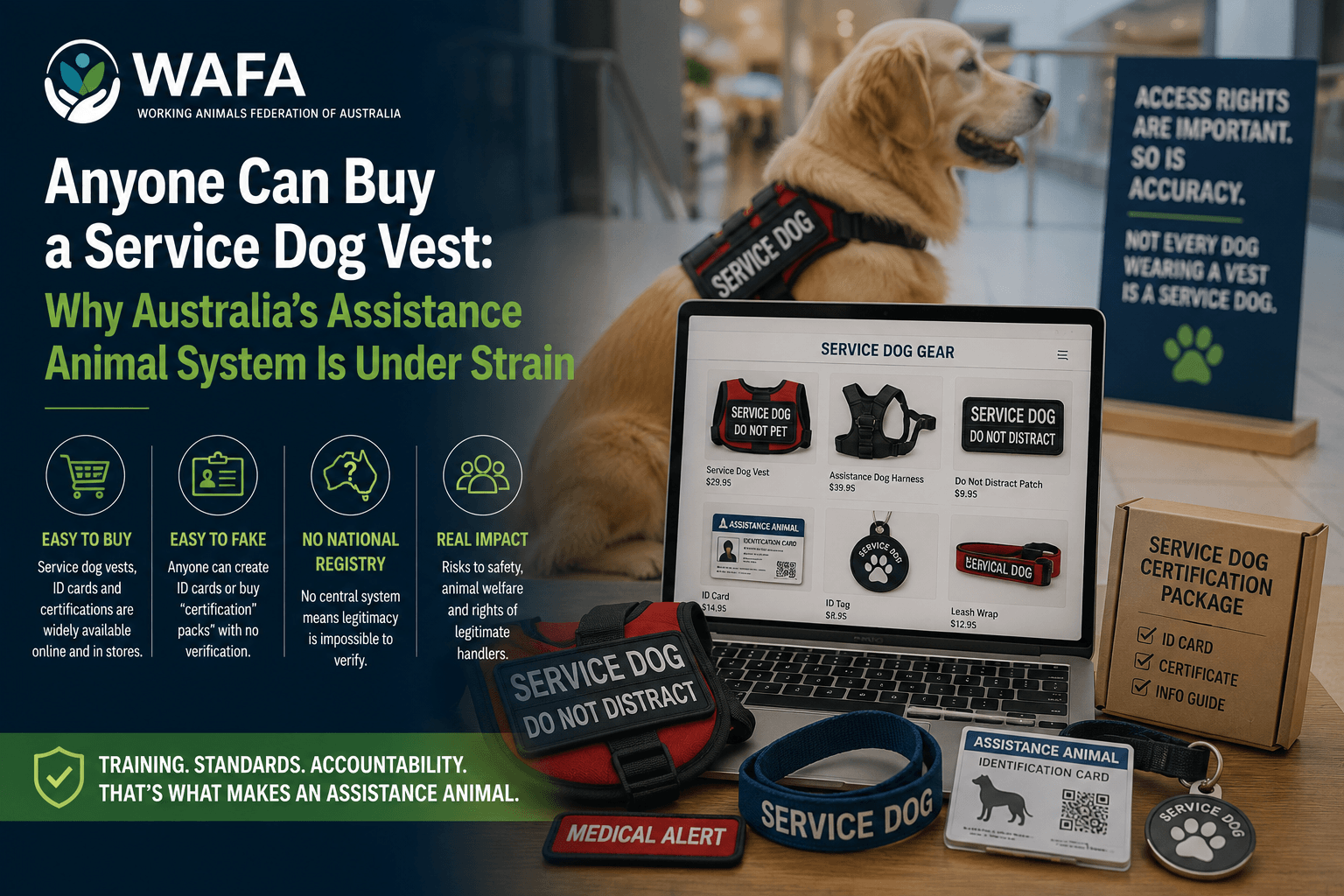
Service dog vests, assistance dog harnesses, embroidered patches, leash wraps, identification cards, QR-coded tags, dog Jibbitz, and branded accessories are widely available from local retailers and international online sellers. Some products come from well-known pet brands, while others are produced specifically for the assistance animal market with labels such as “service dog”, “medical alert dog”, or “therapy dog”. In addition, some custom embroiderers and designers explicitly advertise the production of personalised assistance animal gear.
In the majority of cases there is no requirement for assessment, verification, or oversight of who is purchasing the items or the purpose for which they will be used. This means that people who do not have a disability that meets the Disability Discrimination Act 1992 (Cth) threshold, or whose animal fails to meet the necessary standards, may utilise these items when ineligible to do so.
While this might appear harmless or simply part of a growing pet accessories industry, it has significant consequences for disability rights, public access systems, animal welfare, and community trust.
Looking the Part Is Not the Same as Being an Assistance Animal
Australian law does not define an assistance animal by what it wears.
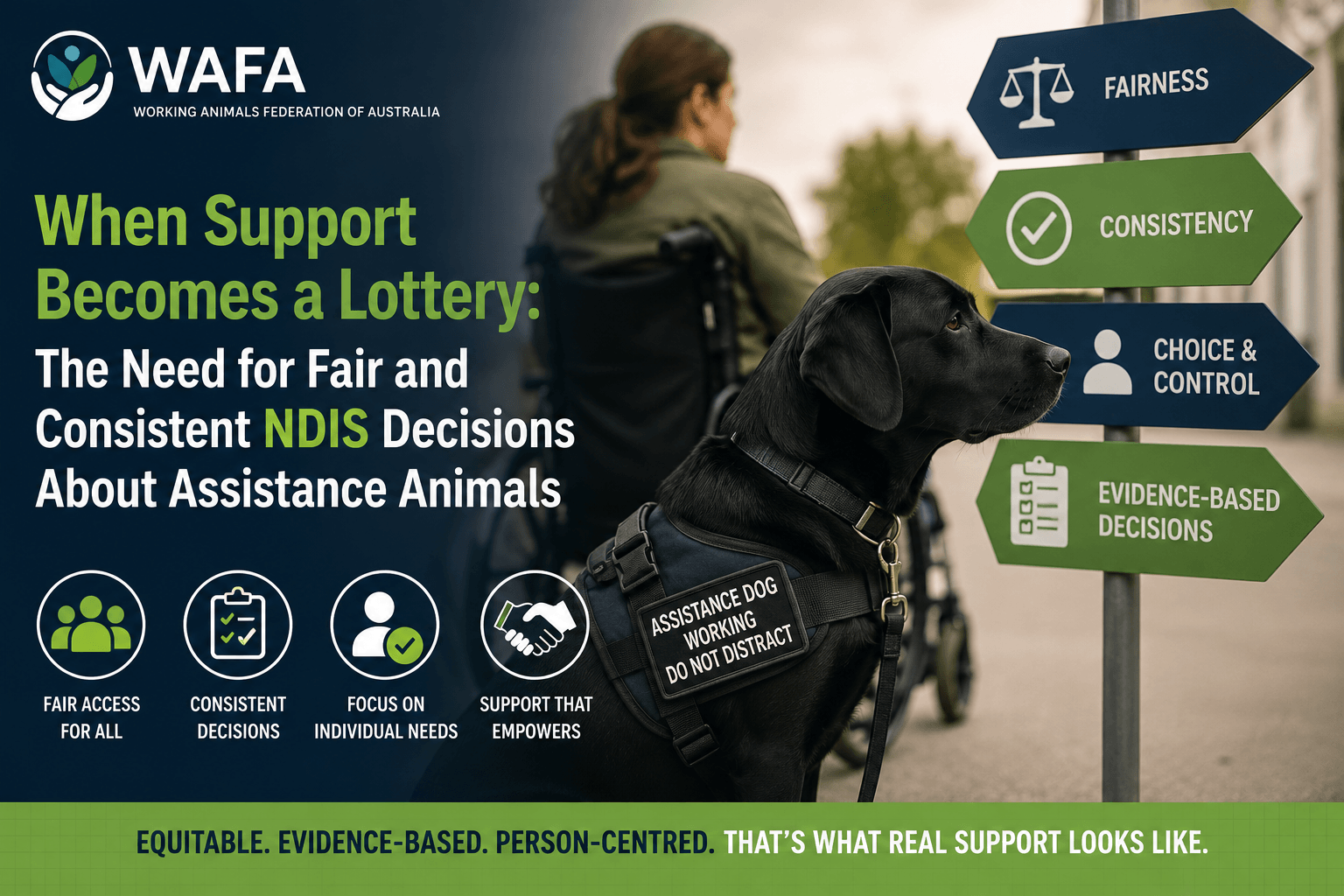
A vest, harness, patch, or identification card does not make a dog an assistance animal.
In fact, there is no legal requirement that an assistance animal wear any form of identification, or even work on leash.
Under federal disability discrimination law in Australia, an assistance animal is defined by its training and function. The animal must be trained to assist a person with disability by performing tasks or behaviours that mitigate the effects of that disability, and must also meet behavioural and hygiene standards appropriate for public access environments.
A dog wearing professional equipment may be a fully trained assistance animal.
It may also be a pet wearing a vest purchased online.
From the perspective of the public, staff, or service providers, there is often no practical way to distinguish between the two based on appearance alone, and many fear the possibility of being taken to the human rights commission for discriminating against a legitimate assistance animal team.
The Ease of Buying “Official-Looking” Equipment
The modern marketplace has made assistance animal equipment widely accessible.
Consumers can purchase:
- Assistance dog vests and harnesses
- “Do Not Distract” patches
- Medical alert tags and collars
- Leash wraps and identification bands
- Vehicle signage
- Assistance dog-themed accessories, including novelty items such as Jibbitz
- Custom embroidered gear featuring “service dog” or “assistance dog” labels
- Online “certification” packs that include ID cards and printed documentation
Many of these products are marketed in ways that imply legitimacy or official status. Some include logos, numbering systems, QR codes, or terminology that resembles formal accreditation.
However, none of these items are, in themselves, proof of legal status or training.
Anyone Can Create an Identification Card
One of the most overlooked issues in Australia is that anyone can create an identification card for their animal.
With basic design software, printing services, or online templates, it is possible to produce highly convincing cards that appear official. Some commercial providers also sell custom ID cards and certificates with minimal or no verification of training or disability status.
Despite their appearance, these cards have no universal legal standing in Australia.
There is currently no single national assistance animal registry, no standardised government-issued identification system, and no uniform credential that automatically grants public access rights.
This creates a system where appearance can be manufactured far more easily than legitimacy can be verified.
The Absence of a National Registry and the Resulting Gap
Because Australia does not have a national assistance animal registry, there is no centralised system to verify:
- Training standards
- Behavioural assessment outcomes
- Handler eligibility
- Public access readiness
- Ongoing compliance or recertification
This absence leaves a significant gap between perception and reality.
In practice, it means businesses, service providers, and members of the public are often left to make decisions based on appearance, behaviour in the moment, or informal questioning.
While legislation provides certain rights and protections for assistance animal handlers, the lack of a consistent national framework creates uncertainty in how those rights are understood and applied in real-world settings.
More Than Confusion: Risks to Safety and Welfare
The accessibility of assistance animal gear and self-issued identification is not just a matter of confusion—it can create real risks.
When untrained or unsuitable dogs are presented as assistance animals, the consequences may include:
- Stress and overwhelm for the animal
- Reactive or unpredictable behaviour in public spaces
- Safety risks to members of the public and other animals
- Disruption in businesses, healthcare settings, and transport environments
- Interference with legitimate assistance animals performing critical tasks
- Increased scrutiny and barriers for genuine assistance animal handlers
For a person with disability, an assistance animal is not a lifestyle accessory. It may be essential to mobility, medical monitoring, psychological stability, communication, or community participation.
Any disruption to that working relationship can have serious impacts.
Undermining the Role of Assistance Animals
When poorly trained animals are presented as assistance animals, public confidence in the entire system is affected.
Businesses may become more cautious or sceptical. Staff may feel uncertain about their obligations. Members of the public may begin to question whether assistance animals are genuinely trained.
This creates a ripple effect that extends beyond individual incidents.
Legitimate assistance animal teams can face increased questioning, barriers, or refusal of access because previous experiences have undermined trust.
In this way, misuse of equipment and identification does not remain isolated—it impacts the broader disability community.
The Terminology Problem: Not All Working Animals Are the Same
A significant driver of confusion is inconsistent terminology.
Many terms are used interchangeably in public conversation, but they do not describe the same roles or legal categories.
A companion animal is not an assistance animal simply because it provides comfort or emotional support. While companion animals can play an important role in wellbeing, they do not automatically have the same legal status or public access rights.
A therapy dog is also not an assistance animal. Therapy dogs are typically handled by volunteers or professionals and provide support to other people in settings such as hospitals, schools, aged care facilities, or courts. Their role is therapeutic and community-based, not disability-specific task work for a handler.
The term service dog adds further complexity. In some countries, particularly the United States, it is commonly used to describe disability assistance dogs. However, internationally, the term is also used for military working dogs, police dogs, customs dogs, and other government service animals. This creates confusion when terminology is imported into Australia without context.
At the same time, online content and product marketing frequently blends terms such as “service dog”, “emotional support animal”, “therapy dog”, and “assistance dog” as if they are interchangeable categories. They are not.
This lack of clarity contributes directly to misunderstanding about rights, responsibilities, and legitimate access.
The Certification Myth
Another widespread misconception is that identification cards, certificates, or purchased documentation provide legal recognition.
They do not.
There is no national system in Australia where buying a vest, ID card, or online certificate automatically grants assistance animal status.
Legal recognition is based on training, behaviour, and compliance with disability discrimination law—not merchandise.
Why Businesses Are Placed in a Difficult Position
Businesses are expected to balance multiple responsibilities, including:
- Compliance with disability discrimination law
- Public safety obligations
- Hygiene and food safety requirements
- Customer experience and comfort
- Risk management
Yet they are often faced with animals wearing convincing equipment and presenting identification that appears official but cannot be easily verified.
This creates uncertainty and inconsistency in how situations are handled across different sectors and locations.
How WAFA Is Working Toward Solutions
The Working Animals Federation of Australia (WAFA) recognises that these challenges cannot be solved by regulation alone. They also require education, cultural change, and improved community understanding.
Through its Ambassador and Ally programs, WAFA is actively working to strengthen knowledge and improve consistency across the sector.
WAFA Ambassadors help share accurate, accessible information about assistance animals, disability inclusion, and responsible public access practices within their communities, workplaces, and professional networks.
WAFA Allies demonstrate commitment to ethical practice, animal welfare, respectful engagement with handlers, and evidence-based understanding of assistance animal roles and responsibilities.
Together, these programs aim to:
- Reduce misinformation and misunderstanding
- Improve public awareness of assistance animal law and practice
- Support animal welfare and responsible training standards
- Strengthen confidence in legitimate assistance animal teams
- Promote disability inclusion and access equity
Education is not a complete solution on its own, but it is a necessary foundation for systemic improvement.
Conclusion
In Australia today, anyone can buy a service dog vest. Anyone can buy an assistance dog patch. Anyone can create or purchase an identification card that looks official.
What cannot be bought is legitimacy.
Assistance animals are defined not by appearance, but by training, behaviour, welfare, and the specific disability-related tasks they are trained to perform.
At the same time, widespread confusion about terminology—between assistance animals, companion animals, therapy dogs, and service dogs—continues to blur public understanding and weaken consistency across systems.
Without clearer education, stronger shared understanding, and more consistent standards, this confusion will persist.
WAFA’s Ambassador and Ally programs represent one step toward addressing this gap by building community knowledge, improving clarity, and supporting both disability rights and animal welfare.
Ultimately, the challenge is not that equipment is available.
The challenge is ensuring that everyone understands what that equipment does—and does not—mean.