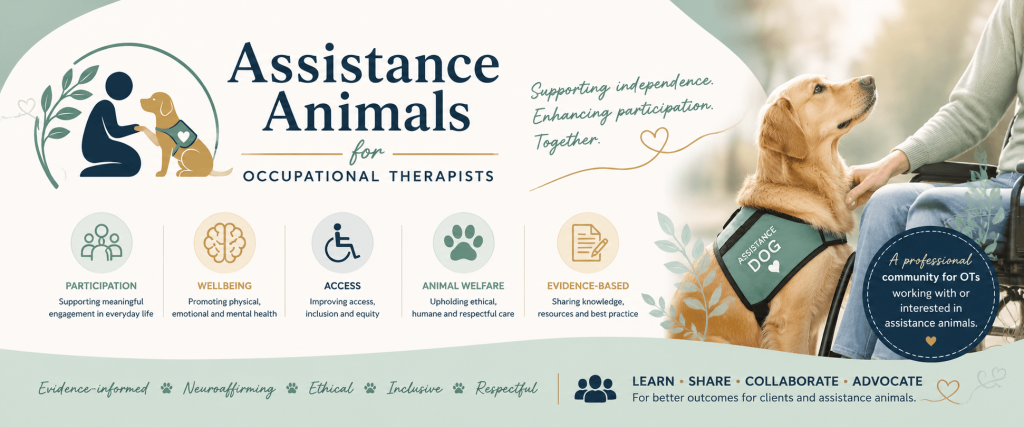
The Working Animals Federation of Australia (WAFA) announces the establishment of a dedicated Occupational Therapy (OT) Community of Practice focused on assistance animal-related practice, delivered through a professional Facebook-based platform.
The OT Assistance Animal Group has been developed as a structured peer learning network and professional knowledge exchange forum, intended to support occupational therapists, OT students, and invited allied health professionals engaged in, or developing competence in, assistance animal-related practice within disability, mental health, and community participation contexts.
The establishment of this Community of Practice reflects an emerging need for interdisciplinary alignment, particularly across occupational therapy, assistance animal training, disability support systems, and regulatory frameworks. As assistance animals become increasingly integrated within functional capacity building, participation-based intervention, and psychosocial support planning, there is a corresponding requirement for consistent, ethically grounded, and evidence-informed professional discourse.
This initiative is positioned within contemporary understandings of communities of practice theory, whereby situated professional learning occurs through sustained engagement, shared inquiry, and collective development of practice knowledge. The group is designed to facilitate peer-to-peer clinical reasoning, reflective dialogue, and the articulation of emerging best practice standards in a developing area of cross-sector practice.
Core areas of focus include, but are not limited to, the ethical and clinically appropriate integration of assistance animals within occupational therapy intervention planning, alignment with functional and participation-based goals (including under NDIS-funded service contexts), duty of care and risk governance considerations, client-centred and rights-based practice approaches, and the intersection of clinical reasoning frameworks with animal welfare and training standards.
The group also functions as a consultative mechanism to inform WAFA’s ongoing development of educational materials, competency frameworks, and professional standards relating to assistance animal practice, with the explicit aim of embedding occupational therapy expertise within broader sector governance and workforce development initiatives.
WAFA emphasises that the Community of Practice is not intended as a promotional or commercial forum. Rather, it is established as a structured professional learning environment to strengthen practice integrity, support reflective and evidence-informed decision-making, and enhance interdisciplinary coherence across human and animal service systems.
From a systems perspective, WAFA recognises assistance animals as situated within complex socio-technical and care ecosystems, requiring coordinated practice between clinicians, trainers, educators, regulators, and service providers. The Community of Practice is therefore intended to support distributed knowledge development, reduce fragmentation of practice understanding, and promote consistency in applied ethical and clinical decision-making.
“Occupational therapy engagement in assistance animal practice requires shared interpretive frameworks, rigorous clinical reasoning, and structured opportunities for peer learning,” WAFA stated. “This Community of Practice provides a mechanism for collective knowledge development in a field that is rapidly evolving and inherently interdisciplinary.”
Membership is open to registered occupational therapists, occupational therapy students, and invited allied health professionals with demonstrable interest or involvement in assistance animal-related practice. Members are expected to participate in accordance with professional codes of conduct, including principles of evidence-informed practice, respectful discourse, and ethical engagement.
This initiative forms part of WAFA’s broader strategic commitment to strengthening interdisciplinary workforce capability, advancing consistent standards of practice, and supporting the development of coherent governance and educational structures within the Australian assistance animal sector.
Practitioners wishing to join the Community of Practice may access the group by emailing admin@workinganimals.com.au