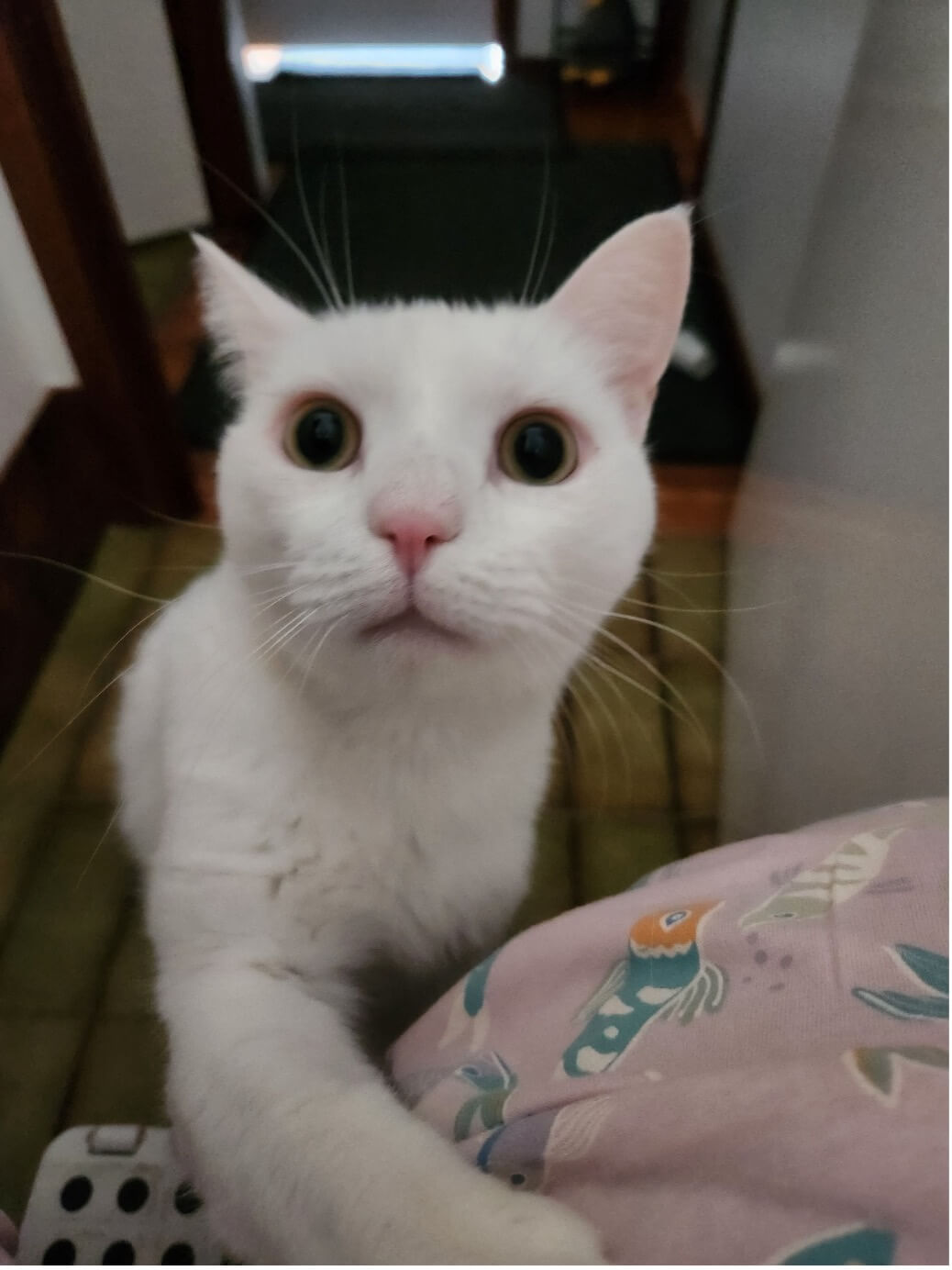
Benson is a white domestic cat with a story that begins long before he ever knew safety, warmth, or the comfort of a steady home. He was named after Olivia Benson from Law & Order: SVU—a character known for persistence, protection, and unwavering advocacy for those who cannot speak for themselves. The name was chosen deliberately, not because Benson’s life was dramatic in a television sense, but because it reflects the kind of resilience he would need simply to exist. When he originally came into care he was named Jon Snow, after the Game of Thrones character, a name that reflected his pale colouring and quiet, observant nature before his identity was later reshaped to better reflect his role in the home and his journey through survival and recovery.
Benson was originally born on the streets, like so many unwanted kittens who begin life without human safety nets. Early survival shaped him in ways that would follow him forever. He was deaf, and even as a young cat he relied heavily on observation, vibration, and instinct to navigate the world. Eventually he was taken in by an older person living with dementia, and as that person’s condition progressed, Benson became caught in an environment where care and harm blurred in deeply concerning ways. He was later rehomed due to escalating neglect and unintentional abuse that the owner was no longer able to recognise or regulate.
Before rescue truly began, Benson spent approximately seven months confined to a bathroom by the owners son, for his own safety. It was a period of extreme isolation that left lasting effects on his development and sense of safety. When he finally came into rescue care, he was fragile but responsive—still seeking connection, still searching for a way to understand people, even after everything he had experienced.
In his second chance home, Benson was adopted not as a formal assistance animal, but as an in-home personal therapy cat—what in the USA would be referred to as an Emotional Support Animal (ESA). In Australia, however, he is recognised simply as a companion animal or pet. That distinction matters legally, but in lived experience, it does not change what Benson became: a stabilising, comforting presence who learned to regulate his environment through closeness, routine, and trust.
He also became the younger brother of Shadow, an assistance cat who has already been featured in an earlier blog. Their bond became one of quiet learning. Benson watched Shadow carefully, not in competition, but in imitation. He began to copy behaviours such as settling beside his handler during distress, leaning in for grounding contact, and offering what could best be described as feline deep pressure therapy—pressing his body firmly against a person’s chest or lap when emotional intensity was high.
Despite his gentle progress, Benson’s life changed again at six years old in a devastating incident. A neighbour, intoxicated at the time, broke into a secure outdoor cat enclosure accessible via the owners house for the 3 resident cats. One cat, Mouse, died as a result of poisoning, and Benson survived but suffered severe consequences. He lost his sight, developed chronic kidney disease from acute renal injury, and sustained significant brain trauma. These injuries reshaped not only his physical health but also his cognitive processing, particularly his memory formation and emotional continuity.
No conviction was ultimately secured due to insufficient evidence, leaving a difficult emotional layer for those caring for him, as the impact on the animals remained very real and permanent.
Since then, Benson’s world has become smaller, softer, and more sensory. He loves food with an intensity that often overrides everything else. He enjoys being pushed in his pram, where movement and security combine into comfort. He seeks out snuggles and close contact, often pressing himself into people with a strong insistence that says more about safety than affection alone. His favourite form of interaction is simply being held or resting in a warm lap where he can feel steady bodies and predictable rhythm.
He also attempted to follow Shadow-everywhere Shadow went, so did Benson. Even months after Shadow’s passing through euthanasia, Benson continues to call out and search. Due to his brain injury and impaired long-term memory formation, he does not retain the permanence of loss in a typical way. Instead, absence feels repeated rather than resolved. Each time he searches, it is experienced again as a fresh confusion rather than an old grief that can settle.
Shadow was shown to him after euthanasia in an effort to support understanding and reduce distress, but even with this, Benson’s cognitive limitations mean that the concept of permanent absence does not fully anchor. His calling and searching behaviour is ongoing, and it reflects not confusion alone, but the way trauma and neurological injury intersect in animal cognition.
For his caregiver, this has required careful adaptation. Supporting Benson has meant meeting him where his brain is, not where human expectation wishes it could be. It has meant managing grief in a household that includes non-human members who also experience attachment, loss, and behavioural change. Euthanasia, while often framed as a singular act of compassion, can have ongoing emotional impacts on other companion animals who shared bonds with the deceased.
Over time, Benson has been supported through structured routine, sensory grounding, and constant reassurance. His needs are simple but profound: food, warmth, physical closeness, and predictable presence. Within those boundaries, he functions not as a broken animal, but as one who has reorganised his entire way of existing around survival.
He is, in every practical sense, a therapy cat. Not because of certification or designation, but because of what he does in practice—he regulates human emotion through proximity, he responds to distress with contact, and he offers consistency in a life that has rarely been predictable.
Benson’s story is not one of perfection or recovery in the traditional sense. It is a story of adaptation after repeated rupture. He did not return to who he might have been before trauma, because there is no version of his life that was ever untouched by it. Instead, he became something else entirely: a small, white presence who continues to show up, again and again, in the only way he can—through closeness, through food motivation, through imitation of love he has observed, and through the simple act of not giving up on connection.
In that way, Benson lives up to his name. Not by solving crimes or chasing danger, but by persisting through a world that has not always been kind, and still choosing to stay near people anyway.