A Gentle Giant in Therapy Work Across a Lifetime of Care
Author: Lisa Grech, Therapy Dog Handler

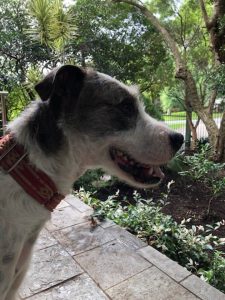 This is Connor. He is a rescue Irish Wolfhound × Great Dane, and a therapy dog. I first met him when he was just one year old, after he was rescued and came into my care. From that early stage, he was already showing the steady, thoughtful temperament that would later define his working life, but more importantly, he was simply mine—my companion, my responsibility, and the beginning of a bond that has shaped both of our lives ever since.
Now in his senior years, Connor continues to serve in a reduced capacity helping children learn to read. Over the years, I have had the privilege of watching him grow from a young rescue into a confident therapy dog and now into an elderly dog who still chooses to participate in work that he clearly finds meaningful and enjoyable. His story, to me, is not just about what he has done in service, but about the relationship we have built together and how that relationship has guided every stage of his working life.
A therapy dog is a trained animal that works alongside a handler to provide structured support to people in community settings. Therapy dogs include those that visit hospitals, schools, courtrooms, police stations, universities, airports and nursing homes, amongst many other environments. Unlike assistance dogs, therapy dogs do not support a single individual with a disability; instead, they interact with multiple people in therapeutic contexts.
Animal-assisted interventions (AAIs) are defined in the literature as structured interactions involving animals to improve human physical, psychological, social, or cognitive functioning (Maujean, Pepping and Kendall, 2015). Systematic reviews have found that dog-assisted interventions can reduce anxiety, improve mood, and increase social engagement in clinical and community populations (Nimer and Lundahl, 2007). In aged care and hospital environments, therapy dog interventions have been associated with reductions in loneliness, agitation, and perceived stress, as well as improvements in social interaction (Barker et al., 2015). These effects occur within structured, supervised programs involving trained handlers and assessed animals (Maujean, Pepping and Kendall, 2015).
Before Connor ever stepped into therapy work, he served as a canine blood donor. This is a role I will always hold in deep respect. Canine blood donation programs are a vital part of veterinary emergency medicine, supporting trauma patients, surgical cases, and critically ill dogs requiring transfusions. While most people never see this side of veterinary care, donor dogs contribute directly to life-saving outcomes. Connor’s early service was quiet and routine, but profoundly meaningful. I don’t know how many dogs lives Connor saved, but I am so proud of his service nevertheless.
At one point in his life, Connor also unexpectedly took on the role of foster father. He cared for a small litter of orphaned kittens who had been rescued after being destined to be used as snake food. Despite his size and species difference, Connor showed an extraordinary gentleness with them, allowing them to sleep against him and move freely around him without any signs of distress or harm.
As Connor matured, I introduced him to aged care and nursing home visits. In these environments, I have consistently observed what research also reflects: animal-assisted interventions can improve emotional wellbeing and increase social engagement among residents (Barker et al., 2015). Even brief interactions have been associated with reductions in loneliness and improvements in mood and communication (Souter and Miller, 2007). In practice, Connor has never been a dog who “performs” in these settings. He does not need to. He simply enters a room, settles, and offers calm, steady presence. For many residents, that alone is enough to shift the emotional tone of an entire interaction.
Now in his senior years, Connor participates in a Story Dog program, where children read aloud to him. This stage of his life feels especially gentle and appropriate. Animal-assisted reading programs have been shown to improve children’s reading fluency, motivation, and confidence, particularly by reducing performance anxiety and providing a non-judgemental listening environment (Beetz et al., 2012). Connor does not correct, prompt, or evaluate. He listens. And in that silence, children often find a sense of safety that allows them to try, stumble, and try again.
Connor’s importance, to me, lies not in a single role but in the continuity of his impact across his life: veterinary transfusion support through blood donation, emotional wellbeing support in aged care environments, and literacy confidence development in children. Research consistently shows that animal-assisted interventions can contribute to improved emotional regulation, reduced anxiety, and enhanced social engagement across age groups (Maujean, Pepping and Kendall, 2015; Nimer and Lundahl, 2007). Connor is a lived reflection of these outcomes.
None of Connor’s work exists in isolation. Everything he has done has depended on a strong, respectful human–animal partnership. My responsibility has always been to ensure his welfare is protected, his workload remains appropriate, and that every interaction is safe, consensual, and genuinely positive for him as well as the people he supports. This partnership is what has allowed his working life to remain sustainable across many years.
Now elderly, Connor’s workload has naturally reduced. His visits are shorter, his rest is longer, and every decision is made with his comfort and wellbeing at the centre. Yet he still goes. Not because he must, but because he continues to enjoy the environments he is part of, and because he is still very much a dog who likes having a purpose.
His legacy, to me, is not defined by a single achievement, but by thousands of small moments: a transfusion that saved a life, a resident who felt less alone, a child who read a page aloud without fear for the first time.
Connor has taught me that therapy work is not about performance. It is about presence, consistency, and relationship. Across a lifetime of service, he demonstrates something I believe is often overlooked: that calm, structured human–animal interactions can meaningfully support emotional, cognitive, and social wellbeing when they are done well, and when the animal’s welfare remains the priority at every stage.
And sometimes, the most powerful intervention is simply a steady presence, a calm listener, and a gentle giant lying quietly beside you.
References
Barker, S.B., Rogers, C.S., Turner, J.W., Karpf, A.S. and Suthers-McCabe, H.M. (2015) ‘Benefits of interacting with companion animals: A systematic review’, Anthrozoös, 28(1), pp. 127–143.
Beetz, A., Uvnäs-Moberg, K., Julius, H. and Kotrschal, K. (2012) ‘Psychosocial and psychophysiological effects of human-animal interactions: The possible role of oxytocin’, Frontiers in Psychology, 3, p. 234.
Maujean, A., Pepping, C.A. and Kendall, E. (2015) ‘A systematic review of randomized controlled trials of animal-assisted therapy on psychosocial outcomes’, Anthrozoös, 28(1), pp. 23–36.
Nimer, J. and Lundahl, B. (2007) ‘Animal-assisted therapy: A meta-analysis’, Anthrozoös, 20(3), pp. 225–238.
Souter, M.A. and Miller, M.D. (2007) ‘Do animal-assisted activities effectively treat depression? A meta-analysis’, Anthrozoös, 20(2), pp. 167–180.